A Cape Town Architect Designs a Coastal Cliff Dwelling
 Noubi Says by NOUBIKKO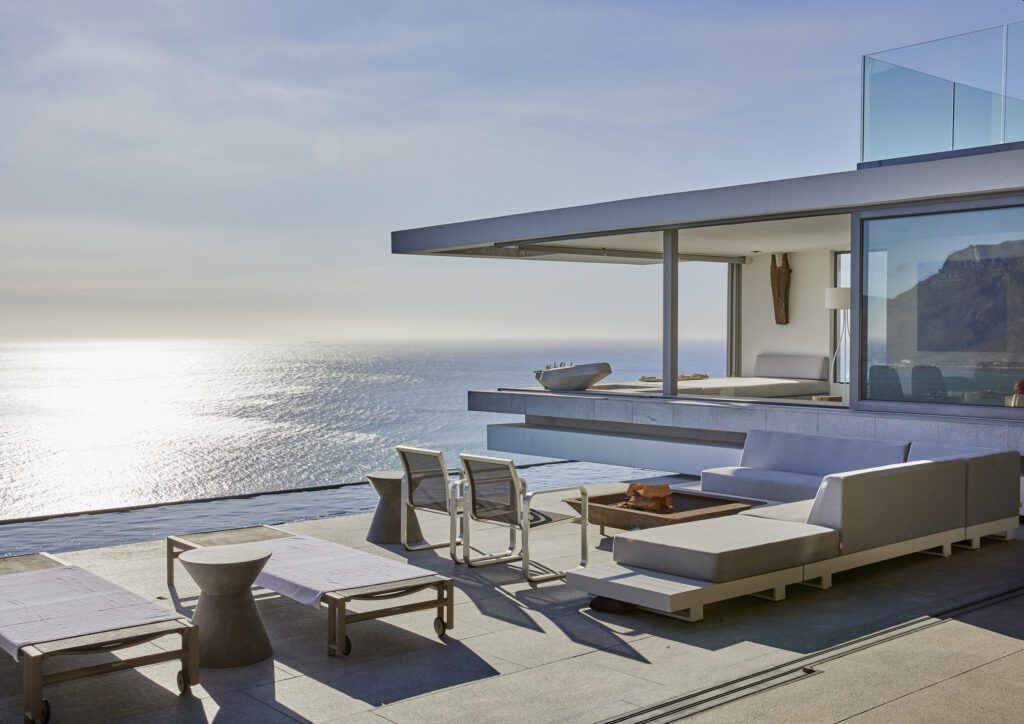
“I’ve always wanted to be in Clifton,” says architect Stefan Antoni. “It’s one of the most beautiful places in the world.” He would know—Antoni has spent decades designing many of the iconic homes that cling to Cape Town’s famed Atlantic Seaboard, earning a reputation for redefining coastal modernism. But this time, the project was personal. While visiting a client’s home on Nettleton Road, he happened to glance up and notice a fallen “For Sale” sign on a vacant stand. “I called the number immediately,” he recalls. “When I found it was still available, I bought it as fast as I could.”
Building his own home offered Antoni something rare: a chance to experiment, to break free from his own design precedents. “I thought, it’s my own house—I can play here,” he says with a grin. Yet the site posed serious challenges. The plot rose sharply from the road, hemmed in by the ocean in front and Lion’s Head behind. “It’s very steep,” he explains. “You have to be clever if you want to avoid creating just another white box on the mountainside.”


AN INVERTED DESIGN
Antoni’s solution was characteristically bold: an upside-down house. Instead of placing the living areas at ground level, he raised them to the top, tucking the bedrooms and recreation zones beneath. The move not only maximized the panoramic views but also connected the house directly to the mountain. “The crucial starting point was getting the house to relate to the mountain,” he says. By allowing the structure to step back as it rises, Antoni carved out a private, north-facing garden at the top—a rarity in Clifton—complete with a stretch of lawn and trees for his ten-yearold son, Luke. “I wanted a space where we could play soccer or cricket or rugby,” he adds. “Having that garden changes everything.”
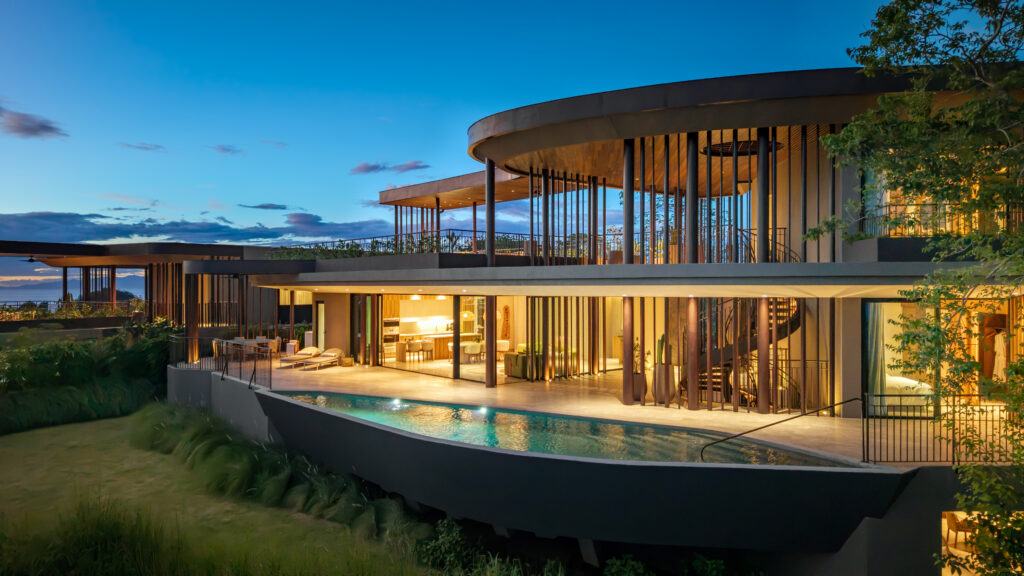
The home’s sculptural form zigzags along the slope: One volume cantilevers dramatically over a rim-flow pool that merges with the ocean below, another extends back toward the rocky hillside. “That modulation creates a wind-free zone,” Antoni notes. “It worked out beautifully.”

VERTICAL HARMONY
The structure unfolds over four main levels, a choreography of vertical and horizontal space. At street level sit the garage and entrance, followed by guest suites a floor below. The games room and family bedrooms occupy the middle tier, connected by a soaring 12-meter atrium. The living spaces— lounge, kitchen, and dining area —crown the home, elevated for light and views.
Despite its complexity, Antoni ensured the house feels cohesive. “Even though we’re on different levels, we’re never isolated from one another,” he explains. “When the kids are in the games room, you can lean over the balustrade and talk to them. It’s about being part of the greater experience.”


A UNIFIED FACADE
The building’s height demanded visual balance. “Each level consists of two floors,” Antoni says, “which meant that balconies and windows occurred only on every second level—it could have looked really odd.” To unify the facade, he wrapped the structure in a laser-cut aluminum screen, an architectural veil that ties the layers together. “It consolidates the design,” he says. “It’s peeled open where the bedrooms need views, and it softens the mass of the building.”
The screen’s pattern, a delicate abstraction of fynbos forms and mountain textures, blurs the home’s edges against the landscape. “It’s not literal,” Antoni explains. “It’s about helping the building recede into its environment—it becomes part of the mountain rather than sitting on it.”


RAW, REFINED, AND RADIANT
“I love ancient monuments and raw, simple spaces,” Antoni says, describing his inspiration. The home’s materials—concrete, stone, and timber—are deliberately robust, offset by moments of delicacy. “It’s about sculpting space,” he continues. “Creating the rawest, most beautiful vessel for experiencing the mountain, the view, and the light.”
This dialogue between raw and refined plays throughout the interior. The boardformed concrete ceiling in the living room, cast with planks whose grain remains visible, gives way to a lighter timber ceiling below— the same planks, brushed down and reused. “Stacking them with the grain visible gave the house a certain lightness and delicacy,” he says. The contrast between industrial materials and sleek balustrades or glass walls adds rhythm and visual tension.
Upstairs, entire walls of glass slide away into hidden cavities, transforming the living area into an open pavilion. “When the glass disappears, it feels like the mountain just slides straight through the house and out to the sea,” Antoni says. “It’s a continuous plane, from rock to water.”


LIGHT, MYSTERY, AND MOVEMENT
Antoni choreographs light with the precision of a sculptor. Because Clifton faces west, the home’s orientation and shading were crucial. “When the late afternoon sun comes around, you can retreat to shaded spaces,” he says. “We don’t need blinds—the architecture itself provides balance.” Skylights and glass slot windows capture what Antoni calls ”the mystery of light,” illuminating walls and art in unexpected ways. “As the sun moves, shadows animate the space,” he says. “It’s always changing.”
He likens the experience of moving through the house to an unfolding story. “I love the mystery of one space leading to another without completely revealing itself,” he explains. “Architecture should be about delight—about playfulness and surprise.”
AN EVOLVING GALLERY
The interiors reflect Antoni’s deep love of modernist art and design. “The house is unashamedly modernist,” he says. Its rooms are punctuated with works by Cecil Skotnes and other leading African modernists, including a large tapestry that once hung in Johannesburg’s President Hotel. “The art and architecture enhance each other—they play off each other beautifully.”
Antoni approaches interiors as an evolving composition rather than a finished tableau. “I didn’t want it to be matched to perfection,” he says. “It had to feel collected, things move around until they find their place.” The effect is more gallery than showroom: a living space that grows richer with time and memory.
A PERSONAL MASTERPIECE
For an architect whose professional life has been devoted to creating homes for others, this project offered rare freedom— and introspection. “It’s been a journey of discovery,” Antoni says. “An opportunity to explore my own aesthetic.” The result is both primal and poetic: a house that feels carved from the mountain itself, yet alive with air, light, and human warmth.
From street to summit, concrete to cloud, Antoni’s Clifton home is more than a building. It’s a meditation on space, a sculptural dialogue between nature and architecture, permanence and play, monument and home.
The post A Cape Town Architect Designs a Coastal Cliff Dwelling appeared first on Ocean Home magazine.